
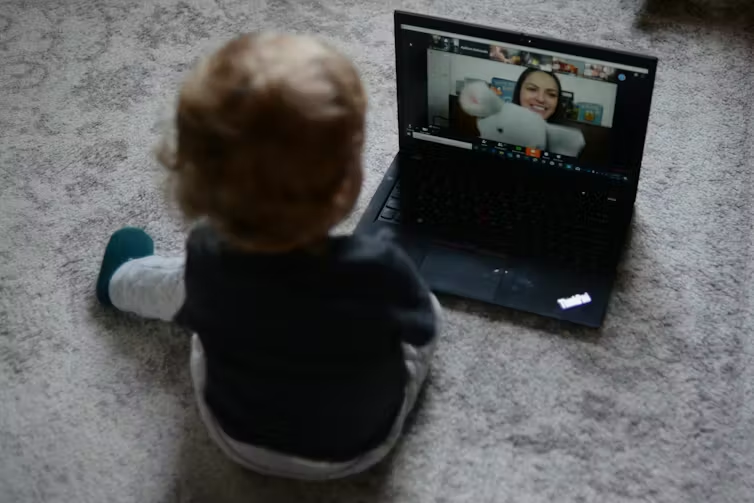
Toronto families experienced the longest lockdowns anywhere in the world between March 2020 and June 222022. Ontario closed its schools for in-person learning for more than 27 weeks. This was longer than any other province or territory. Government restrictions were placed on public places for several months. The parents were left to find a way to balance work, childcare, and virtual school.
We asked mothers with young children how they manage their children’s media consumption during this turbulent time.
Our study is part of a larger research collaboration with researchers from Australia, the United States, China, Colombia, South Korea, and the United Kingdom.
The experiences of children with media can be vastly different depending on the context. For example, government regulations or socioeconomic differences.
In our interviews, we found that mothers are constantly under pressure to manage their children’s technology usage. These new realities require support for mothers.
Media use is constantly renegotiated.
We interviewed 15 mothers from the Greater Toronto Area via Zoom between January 2022 and July 2022. Facebook groups for neighborhood parenting groups recruited parents and caregivers. Only mothers responded. Participants were based in Toronto, Burlington, Niagara, and North York.
Most were middle class. Most were middle class. The answers to the question of self-identification of the racial or ethnic background of both parents included Southeast Asian, Chinese and Jewish, Scottish, Chinese Canadian, and Canadian.
During the entire pandemic, mothers shared that they were constantly re-evaluating and renegotiating their children’s use of technology. The negotiations focused on screen time and the home environments where children use technology.
Moral implications were a part of these negotiations and decisions. These decisions and negotiations were also influenced by the values and practices of families, as well as anxieties over children becoming adults and nostalgia about mothers’ childhoods when technology was less complex.
Balancing time
The mother’s reflections on screen time are messy, complex, and often contradictory.
Mothers construed screen time as being “good” when it included skill-building opportunities, educational opportunities, communication between friends and family, or an activity that involved the whole family (such as watching movies, playing video consoles, or online games).
They viewed video games played with friends or alone as more dangerous. They were worried about addiction and isolation. Families have adopted strategies to monitor screen time, including using timers and scheduling screen time. They also limit children’s access to WiFi and devices.
Guilt for letting someone down
Many mothers mentioned recommendations by pediatricians and researchers regarding screen time. They felt these guidelines put immense pressure on them and their children as parents during this pandemic. Although they described these guidelines as ideals, it wasn’t easy to follow them.
A mother said: “I think we’ve broken every rule.” She described the parenting style during this pandemic crisis as “an impossible balance,” where “the TV [is] now the parent, because I need to do my work so I can generate an income.”
The increased use of technology at home and the increased screen time of her children was linked to “guilt” about letting down her kids by not being able to interact with them or by “ignoring tasks.”
Balancing space
The “impossible” balance was not only the amount of time spent on screens but also which screens and where they were used (for leisure or school). The lockdowns had a dramatic impact on families’ domestic space.
The open-concept house made it easier to observe what the kids were doing with their technology but was distracting for parents and children who were trying to learn and work from home.
This arrangement allows both parents and children to focus on their work during the day. This arrangement, however, made it difficult for parents to monitor what their children were doing online.
It was a heavy toll.
Some parents didn’t have reliable WiFi in every room of the house. Voice-assisted technologies such as Alexa also allowed the digital to invade areas that were previously tech-free.
Many mothers have found that they need to be near their children when attending online school to help them stay focused and to assist with technology. It was especially difficult for mothers with two or more children.
A mother said that she was “ping-ponging” back and forth between her two children while supporting them online. It wasn’t easy to keep children while working from home. As short lockdowns turned into months, many mothers felt frustrated.
Some parents were able, for the first time, to transcend their school-home binary. Parents who supported and closely monitored their children’s online education had a better understanding of the dynamics in classrooms between teachers, students, and curriculum.
Families have changed dramatically since the advent of technology
The pandemic continued, and decisions and negotiations about screen time, where it happened, and how much screen time was allowed in the home were ongoing. It may have been impossible to get everything “right.”
The pandemic affected the way families used technology. As families acquired new devices, platforms, and apps, some children were exposed to technology for the first time. With online school, for example, every child has a device. It affected the way mothers manage their children and family’s time and space.
Concerns over being a good parent influence the decisions mothers make about their children’s screen time, worries for the future of children and their childhood, as well as work-from-home realities.
It is impossible to return to the tech-filled home of pre-pandemic days. Many kids have new devices and spaces in which to use them — as well as expectations that they will use technology to do activities previously done offline.
Accept shared responsibility
Screen time guidelines from medical professionals are not enough. They do not take into account the complexity of technology in families. Guidelines for screen time are not able to account for the complex technology used by families.
To help families navigate these new realities, we need to have broader discussions, including social networks, educational technology companies, and schools.